





Academic Achievement
- Home
- About
- Academic Achievement
- 2024 Academic Publications
- The Relationship Between Post-Thaw Blastocyst Re-Expansion and IVF Pregnancy Outcomes
The Relationship Between Post-Thaw Blastocyst Re-Expansion and IVF Pregnancy Outcomes
Share
Presented by NUWA Fertility at the 2024 Taiwan Society for Reproductive Medicine (TSRM)
At the 2024 TSRM annual meeting, NUWA Fertility presented a study exploring the association between blastocyst re-expansion after thawing and subsequent implantation and pregnancy success. The findings provide valuable insights for refining embryo selection criteria in frozen embryo transfer (FET) cycles.
Background: Does Post-Thaw Expansion Matter?
With advancements in vitrification, the success rate of frozen embryo transfers has significantly improved. However, following thawing, blastocysts undergo a period of re-expansion, which may reflect their viability.
This study aimed to evaluate whether the degree of blastocyst expansion after thawing is correlated with implantation potential and overall pregnancy outcomes.
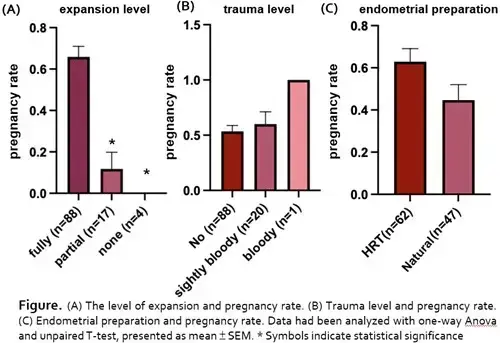
Key Finding: Fully re-expanded blastocysts had higher pregnancy rates compared to partially or non-expanded ones.
Results: Full Re-Expansion Indicates Greater Implantation Potential
The study clearly demonstrated that fully re-expanded blastocysts post-thaw showed significantly higher clinical pregnancy rates compared to those that were only partially expanded or not expanded at all.
This highlights post-thaw morphological recovery as an important marker of embryo viability and implantation potential.
Interestingly, the study also found that medication protocols and the presence of minor bleeding at the time of transfer had no significant impact on pregnancy rates—further reinforcing the importance of embryo quality and recovery behavior over external factors.
Clinical Implications: Re-Expansion as a Key Morphological Indicator
These findings suggest that embryologists and clinicians should carefully evaluate the degree of blastocyst expansion after thawing when selecting embryos for transfer.
Incomplete or delayed re-expansion may indicate underlying embryo quality issues or suboptimal vitrification processes, warranting additional caution during selection.
NUWA Fertility will continue to monitor and evaluate key post-thaw indicators to improve embryo selection strategies.
By focusing on morphological recovery after thawing, we aim to deliver more effective and personalized FET protocols, ultimately helping more patients achieve successful pregnancies.